High-Performance Insulation: R-Value Optimization for Extreme Cold Climates
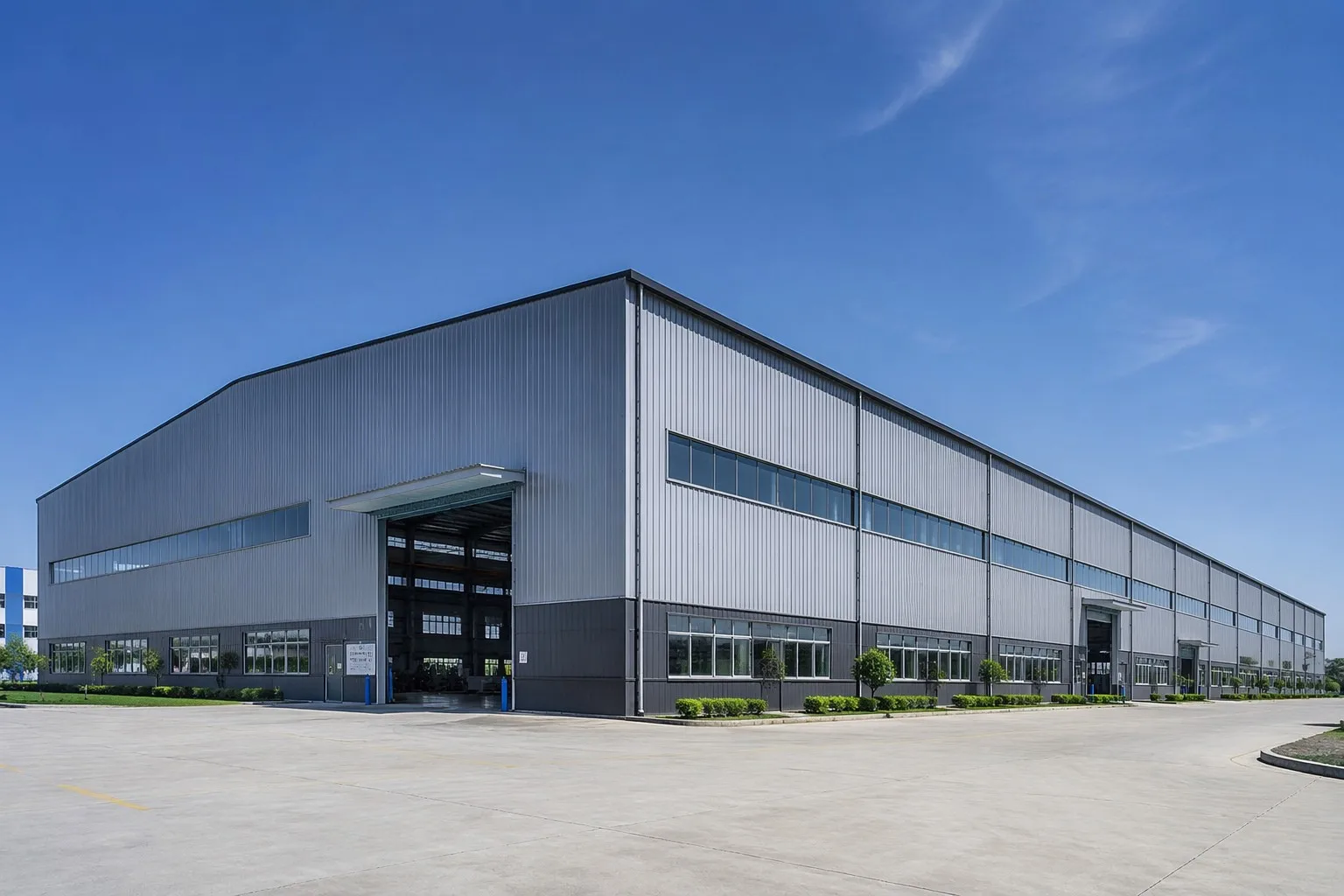
In a cold climate the steel frame is easy. Keeping the heat inside it is the hard part. A building that performs well at 0°C can suffer condensation, ice formation and 40% higher heating costs at −30°C unless the envelope, thermal breaks and air barrier are designed together.
Target R-Values by Climate Zone
These are practical design targets for warehouses and workshops, covering roof and wall assemblies:
- Moderate cold (design temp −10°C): roof R-25 (RSI 4.4), wall R-18 (RSI 3.2).
- Cold (−20°C): roof R-31 to R-38 (RSI 5.5–6.7), wall R-24 to R-28 (RSI 4.2–4.9).
- Extreme cold (−30°C and below): roof R-45 to R-60 (RSI 7.9–10.6), wall R-32 to R-40 (RSI 5.6–7.0).
- Refrigerated or cold-store spaces: roof R-50+ and wall R-40+, with continuous insulation and a full vapour barrier, plus thermal breaks at every penetration.
Insulation Types and Where They Win
- EPS sandwich panels (expanded polystyrene, roughly 0.035–0.038 W/m·K): economical for mild to moderate cold, 100–200 mm thick. Not suitable below about −20°C duty without careful detailing, and combustible without additives.
- Rock wool panels (0.040–0.045 W/m·K): non-combustible, excellent fire performance, good acoustic absorption. Heavier and slightly more expensive; the standard choice where fire rating drives the specification.
- PIR / PUR panels (0.022–0.026 W/m·K): the best insulation value per millimetre, which matters when structural depth is fixed. Typical 100 mm PIR gives roughly R-23 (RSI 4.0); 150 mm gives about R-34. Ideal for extreme cold where you cannot thicken the envelope.
- Glass wool / mineral wool blanket with liner: used in long-span roofs with a separate standing seam sheet above; cost-effective, but thermal bridging through purlins must be managed.
- Spray polyurethane foam: excellent air sealing and no thermal bridging gaps on irregular details, but requires skilled application and careful fire compliance.
The Thermal Bridge Problem
Insulation only insulates where it is continuous. In a steel building, purlins, girts, clips, and frame members all cross the insulation line. A 2 mm steel purlin has a thermal conductivity around 50 W/m·K — roughly 1,400 times that of PIR foam. Where purlins penetrate a 150 mm insulation layer every 1.5 m, effective performance can fall by 15–30%.
Solutions include: a thermal break strip or pad under the purlin or girt, external insulation with rainscreen cladding outside the frame, and using standing seam roofing over a separately insulated deck so the purlins sit inside the conditioned envelope rather than crossing it.
Vapour Control and Airtightness
In cold climates, moisture migrates from the warm interior to the cold exterior. If it condenses inside the insulation, performance collapses and the steel rusts from the inside.
- Place the vapour barrier on the warm side of the insulation, continuous and sealed at every lap, penetration and junction.
- Design the assembly so its dew point stays outside the insulation: a common approach is a vapour-tight interior liner plus a breathable external layer.
- Achieve airtightness through lapped and taped liners, sealed penetrations, gasketed doors and closing of all gaps at eaves and ridge — targets around 3–5 m³/h·m² at 50 Pa are achievable with care.
- Ventilate deliberately. Industrial buildings need controlled fresh air intake, not accidental infiltration; heat recovery ventilators pay back quickly in cold climates.
Doors, Windows and Details
Openings are where cold-climate performance is lost. Specify insulated sectional doors with a U-value of 1.5 W/m²K or better, thermal breaks in door frames, lobbies or air curtains at high-traffic doors, and triple glazing with warm-edge spacers for offices. Also check that the structural connection between an insulated envelope and a cold foundation includes a thermal break — a classic cause of floor-edge condensation and ice.
How to Specify It
State the design outdoor temperature, the required indoor temperature and the internal humidity level (this drives the vapour strategy more than anything else). Pingchuang will recommend panel types and thicknesses, thermal break details, and a documented envelope build-up that meets your target R-value.
Cold-climate project? Get an insulated envelope design
Send your drawings, span, height and site location — our engineering team will reply with a preliminary design, steel take-off and quotation within 24 hours.
Get a Free Quote Now Chat on WhatsApp
Direct inquiry: kevin@steel-structure-manufacturer.com | WhatsApp / Phone: +86-15600895677